Showing posts with label beer. Show all posts

Friday, April 28, 2023

Sourdough Stories, Part 14: Homebrew Beer Bread!

If you've been around a while, you know The Hubs is a homebrewer.  We've been making beer since before we had Lil' Man (mostly him--I help with cleaning and any tasks that require an extra set of hands).  Which got me curious: I know there are plenty recipes for "quick" beer breads, but what about a SOURDOUGH beer bread?  The Googles sent me to King Arthur's recipe, which calls for "malted flaked wheat".  


But we're HOME BREWERS.  We don't need King Arthur's fancy-schmancy stuff, right?  I hit up the local homebrew store to talk with the owners.  At which point they informed me that they carry "flaked wheat", and "malted wheat"...but had never heard of "malted flaked wheat".  After some more Googling, we realized that this ingredient is apparently an invention of King Arthur, and at $17/bag, they're quite proud of it.

We deliberated over the benefits of going with one or the other: the flaked wheat would be closer to the texture, but the malted wheat would provide a more malty flavor. I decided flavor was more important (because the cracked wheat would add it's own, interesting texture).  Then they asked, "red wheat, or white wheat"?  Todd, one of the owners, noted white wheat would be more mild, while the red wheat would add some spicy or peppery notes.  I chose the red, which they milled for me onsite (not down to flour, but cracked to allow better access to the starches inside).  They sold me a "heaping cup's" worth for a whopping 50 cents. TAKE THAT, KING ARTHUR!!!  HUZZAH!

Also picked up some wheat & rye flour at the bulk foods store.

After learning my lesson with some previous recipes, I made sure we started this one with a VERY happy, bubbly starter, which I'd added some whole wheat & rye flour to for an extra boost of nutrition. And we transferred Mandough into a much more appropriate container. 


Since this recipe varies a bit from the original, I decided to share my version below.

INGREDIENTS:

Soaker: 120g of malted red wheat, milled + 113g boiling water (combine & set aside for later)

Dough:

  • 227g active, bubbly starter
  • 255g homebrew (we used a Dunkel)
  • 210g AP flour
  • 210g bread flour
  • 21g raw honey
  • 12g salt

DIRECTIONS:

Combine & set aside your soaker for later.  (Note: this smelled like Grape Nuts and I kinda wanted to try a bite.)  


Somewhere in this process, another major difference between malted wheat and flaked wheat occurred to me:  flaked wheat will soak up all of the boiling water.  BUT...the same is not true of just the cracked wheat.  So by going with the malted wheat, I was giving my dough a higher hydration percentage.  If you wanted to play around with this and make something with more internal structure to it, I would recommend actually cooking the wheat in the water, maybe in the microwave for a while, to steam off some of the extra water and soften up the grains a bit more.  
Our homebrew dunkel--and yes, I drank the rest of the bottle while prepping the dough.

Next, combine your starter, beer, and flours in a stand mixer with a dough hook and let it go for about 3 minutes on the lowest speed.  Then let it rest for 30 minutes (autolyze).   After the rest, add the soaker, honey, and salt, and mix on the lowest speed for 1 minute or until fully incorporated. 

Then turn the mixer speed up by ONE and let it go for about 3-4 minutes. It should be somewhat tacky but fairly soft and supple.  The extra hydration from the malted wheat soaker will make it a fairly loose dough.  Cover and let it rise for 1 hour.

Turn it out onto a lightly floured surface and gently fold (I like the envelope fold) a few times, stretching the dough as you go. This is a high hydration dough so it won't be too difficult. Then place it back in the bowl and rest for another hour.

After the hour has passed, repeat this folding process and let rest for one more hour (should be at a total of 3 hours of rise time at this point).  Because this is such a high hydration dough, it might warrant some extra folds. Note: if  did this again, I'd use all bread flour to help add some extra gluten & structure.

After the final rest, turn out onto a floured counter & shape into a round (Note: because of the extra hydration, you could also roll this & put it into a loaf pan to add some structure.). Cover with lightly greased plastic wrap & let set for 20 minutes.  As you can see--my round kept flattening out.  So I did a few extra folds in an attempt to give it some more structure.

After that rest, I tried to shape it into a slightly tighter round, placed a floured tea towel in a bowl, and then turned the boule into the bowl, seam side up, & let rise for another 3ish hours.
Post-rise.

Then I turned it back out onto the floured counter, attempted to tighten into a boule (again), cut a few slits with scissors.  I preheated the oven with a pizza stone to 450F, and added a high sided cookie pan to the lowest rack.  When it was time to put the boule on the pizza stone, I also added a cup of boiling water to the cookie sheet for steam.

Bake for 15 min at 450F, then 25-30 minutes at 400F. Then remove from the oven and let cool on a baker's rack.
Scissor cuts kinda turned into heart shapes. 

Result: flat-ish loaf that made long, skinny slices which are too long for the toaster.  Slightly tough crust.  But very flavorful.  
Also made great garlic bread.

Sunday, August 4, 2019

Adventures in Homebrewing: DIY Kegerator / Keyser!

Last week we talked about making the switch to all-grain brewing...and the kegerator wasn't far behind.  

We held off on the kegerator for a long time, because we like to have a variety of beer around the house.  Bottling allows you to store several batches for a long time and have tons of variety in the fridge.  But...cleaning, sanitizing, and capping each bottle is also a huge pain in the butt, and we, like many brewers, have dealt with the annoyance of having some of your bottles not get clean enough and ending up with some random funky off-flavors in a normally drinkable beer.  
Dunkel--the last batch we bottled before making the switch. Unfortunately, our ratio on priming sugar was off and these ended up under-carbonated, so we had to uncap them all, add more priming sugar, and then wait another several more weeks until they were ready to drink, while praying they didn't explode.

With kegging, you're just getting one big vessel super-spankin' clean--and it's a heckuva lot easier to get to all the nooks & crannies.  Also, if you want to force carbonate your beer right after you're done with fermentation, you can, rather than bottling and then waiting 2-4 more weeks for them to carbonate. So...we finally pulled the trigger.
Step 1: Find a freezer & convert.  So, technically this is a "keyser" because we made it out of a freezer rather than a fridge, but either will work.  We had a small chest freezer out in our garage, so we upgraded to a larger upright freezer for storing food, and moved the chest freezer into a storage room in our basement with some extra space (room temps in our basement stay more consistently cool, so this was preferable to having it in the garage where temps fluctuate more and would require more energy from the system). 

It has enough room for two pencil kegs (each holds 5 gallons).  We see similar models pop up frequently on Craigslist & Facebook Marketplace--you can find one for $50-75.  You'll have to turn the internal temperature of the unit up to about 40F, so that it functions as a fridge rather than a freezer.  We  installed a digital temperature controller--attached the temperature probe to the outside of one of the kegs (covered with insulation, so it's measuring keg temp, not ambient temp inside the kegerator) to check beer temp, and then the freezer plug-in connects to the controller to tell the freezer when to kick on and off to maintain temp. (Note: if you start with a fridge rather than a freezer, this step isn't needed.)

Step 1a: Buy Kegs & CO2 tank - We found ours on Facebook Marketplace and Craigslist--$100 for a 20 lb filled CO2 tank is a good price.  Our unit fits two pencil/soda kegs.  You can get pin-lock kegs for about $35, or ball-lock for about $40: ball-lock is preferred, as they're more interchangeable.  When you get these home, you'll want to clean them well, and then do a pressure test to make sure they don't have any pin-holes or leaks in them.  We'd also recommend replacing the seals (they're cheap) so you know when that was done last.  You'll also need a CO2 regulator for the tank (there are multi-valve models available if you want the option to vary the amount of CO2 pressure you mix for different types of beers.)

Step 2: Make a collar:  So you don't have to drill through the unit to install the taps--then if you want to convert it back into a regular freezer later, you can with no issues.  Disconnect the hinges to remove the lid, measure dimensions, then cut boards to fit and glue + screw together, with caulk on the inner corners for a good seal.  You can vary what size boards you choose based on your preference--we went with a 2x12 to give us a little more room for taller kegs (plus we already had them on-hand from replacing deck boards earlier this year).  We also stained the wood after assembly (you could do chalk paint instead if you want to be able to write what beer's on which tap).  And on the short edges, there's an additional board along the inside of each end that extends down into the cooler to stabilize the collar and keep it from falling in.

Step 3: Install taps & manifold -  Stainless steel faucets are recommended over chrome (if your faucets don't come with a spanner wrench, you'll need to buy one to install them properly).  Drill holes (using a step drill or hole saw) into the collar at a size that matches the shank of the faucet--our faucets came with a 2-inch shank which wasn't quite long enough, so we replaced it with an extension shank.   

Then drill one small hole in the collar (ours is on the back corner) for the CO2 line to run into the kegerator (we store the CO2 outside of the kegerator).  Mount the manifold on the inside of the collar.  This is what allows you to run CO2 from one tank to multiple kegs.  These can come with multiple numbers of check valves, depending on how many taps you plan on having.

Step 4: Hooking up TubingWe got quick disconnects--they're color coded and connect on the keg end.  We used Bev Seal Ultra Tubing.  It's heavy duty and will take some manipulation (heating with heat gun and/or hot water) to soften the tubing to slide onto the disconnects, but once it's on, you're set--they should never leak.  Then we have John Guest fittings which connect to the tap end: the tubing should just slide into the fitting and click when it's in place.
John Guest fittings on the back side of the taps.

For a 2 keg system, you'll have 5 connections:
  • CO2 tank regulator to Manifold (barbed fittings, no connectors)
  • (2) Manifold to Keg (barbed on manifold end, quick disconnects at Keg)
  • (2) Keg to Tap (quick disconnect at keg-end, John Guest fitting at tap) - check out this article about line balancing regarding the length of tubing you should use to keep foam down.

Step 5: Insulate the collar (optional) - more for energy-savings than anything.  We got some pink insulation board from Home Depot. We also used weather strip seal on the top and bottom edges of the collar (where it touches the freezer).

Step 6: Install drip tray - ours is a magnetic "tool tray" & sticks to the freezer.  Found it at Harbor Freight.  Others opt to screw it in to the collar.

Step 7: Leak Check - Once everything is connected, spray all the connections/fittings with sanitizer (including tops of kegs) and watch for bubbles.  If no issues and you don't see your CO2 gauge drop after 1 day, you're good to go!

Step 8: Add fan (optional) - this circulates the air within the unit to help keep a consistent temp (which helps keep foaming down). Any CPU fan will work, but you'll have to adapt the wiring.

Final Product:

Interior


Saturday, July 27, 2019

Adventures in HomeBrewing: Making the Switch to All Grain Brewing

As most of you know, we have been home brewing for a while now. It started about 5 years ago when I got the The Hubs a Groupon for a 5-gallon bucket system and a brewing class from our local homebrew store.  It should be noted--The Hubs does most of the brewing--I help with sanitizing, cleaning, stirring when his arm gets tired, handing him things, acquiring bottles, and bragging on him since he's his own worst critic.  
Our first batch in 2014, an American Bock (this is a really solid kit, FYI. Great beer).

We did extract-based kits for most of that time.  If there are any non-brewers reading this: one of the first steps in brewing is the mash--which is steeping crushed or cracked grains in warm water to extract the starches & convert them into fermentable sugars, forming the "wort" or beer base.  In order to simplify/expedite the home brewing process, you can buy malt extract which comes as either a dry powder or a thick syrup.  This process requires less equipment so it's a good option for those who are new to homebrewing, or who don't have time/space for the full process.
We slowly upgraded our equipment--first getting a copper coil wort chiller to speed up the cooling process (rather than doing an ice bath in the sink), and then getting a conical fermenter so we could easily remove sediment and then bottle directly from it, rather than having to transfer beer from the fermenting bucket to the bottling bucket.  
The hydrometer that came with the basic brewing kit was tough to read and we were concerned we weren't getting accurate ABV calculations, so we got a refractometer which seems to be working better.
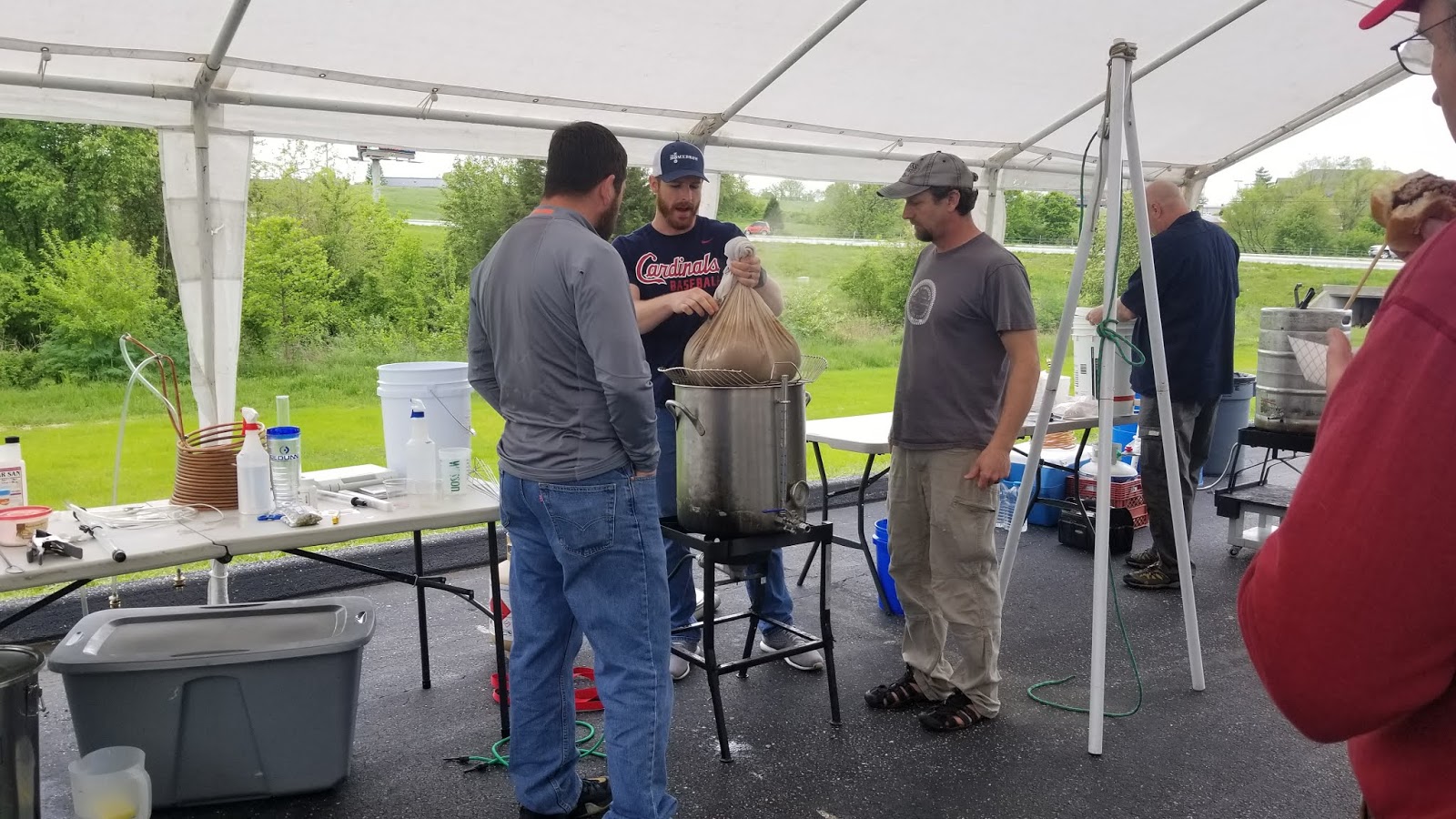
About a year ago, The Hubs joined a local home brewers group, and we went to several Big Brew Days where the brewery store would demo different brewing methods.  

The Hubs took a class on all-grain brewing a couple years ago, but we held off for a long time because the process just takes longer--We could make a 5 gallon batch of beer using an extract kit in about 3 hours (aka, during Lil' Man's nap), whereas all-grain takes about 5-6 hours--so it's more of an all-day process.

But there's also a cost trade off--malt extract kits run about $30-50, depending on the type of beer.  But with all grain brewing, buying the raw ingredients is cheaper--a typical all-grain kit is around $20-25. If you brew enough to buy in bulk, you can save even more. 
Bulk buy of ingredients for three batches of beer.  We were having them double-mill the grains at the store, but we've also since bought a grain grinder so we can buy raw grains and mill them at home.

I think the breaking point for us was when The Hubs wanted to brew a high ABV double IPA...it required so much malt extract that the total price of the 5 gallon batch was around $80. 
So we finally made the switch to all-grain brewing: The Hubs bought a Brew In The Bag and I got him BeerSmith recipe software for Christmas. As an intermediate step, we did an Imperial pumpkin ale as a partial mash--it was the last batch we did fully on the stovetop with a 3 gallon pot. Then last year we bought an outdoor propane system on sale at Bass Pro Shops over Black Friday.
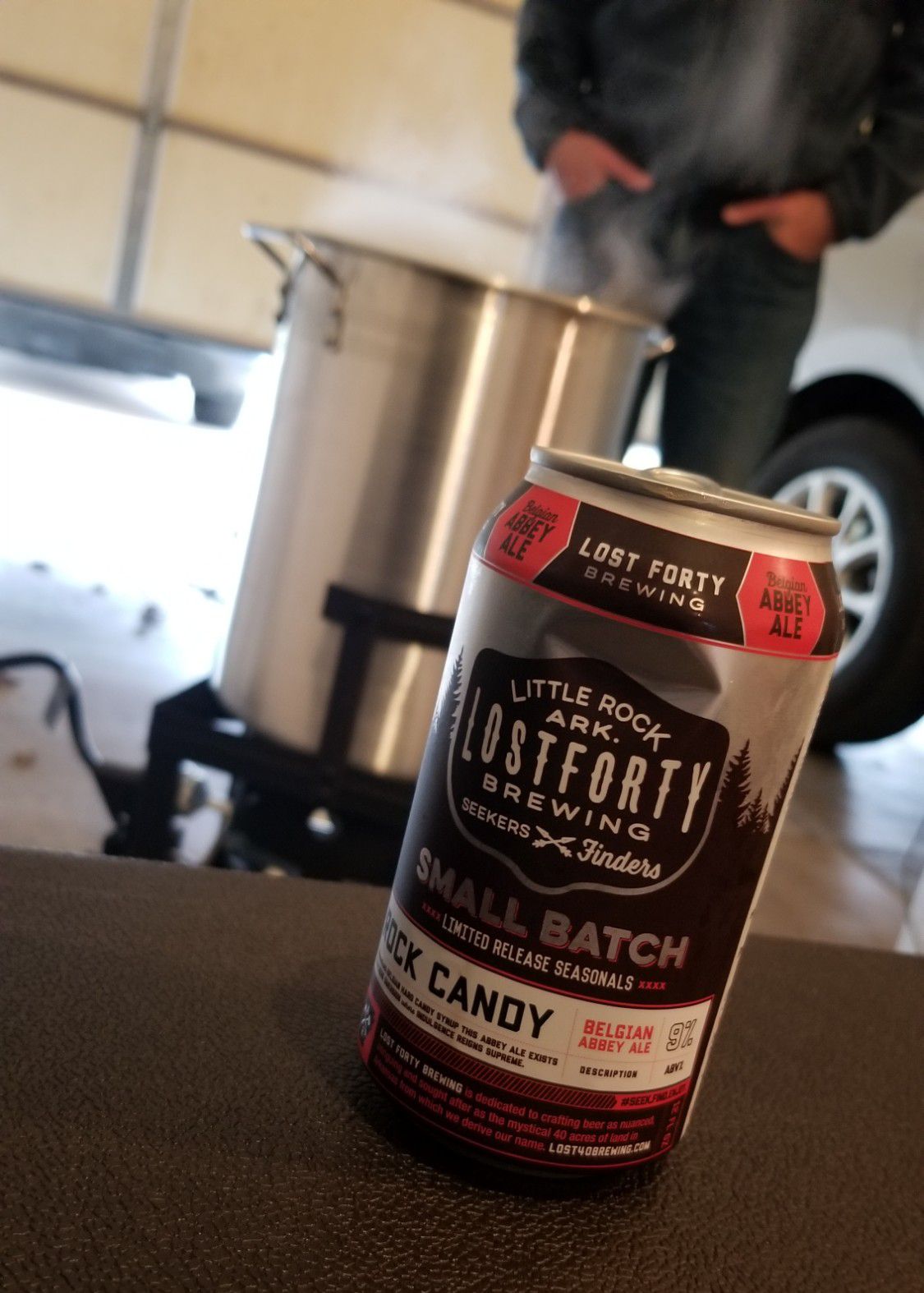
Inaugural use of the turkey fryer, making a "Miller Light" clone, while drinking delicious Rock Candy from Lost Forty in Arkansas.

We still mash on the stovetop because it's easier, and then move to the turkey fryer for the boil.
Since making the switch, we've brewed 6 beers using all-grain: a Miller Lite clone, Irish red, dunkel, rye IPA, vanilla porter, and an English mild (note: if you're interested in any of these recipes, comment below and we'd be happy to share).  The Hubs prefers to brew when it's colder outside, since the turkey fryer has to be used outside and generates a lot of heat, and our fermenter is installed in our basement, so the temperatures stay a little cooler and more steady for better consistency.

The Hubs won 3rd place for its category with his Irish Red at this year's Ozarks Open--though technically he brewed that on a friend's system.
On deck next we're going to try doing a kettle sour (I promise a whole post on that once it's ready to drink).

After making the switch, it was just a short jump to moving away from bottling to having our own kegerator.  I'll have a  post about how we built our own kegerator up next week--stay tuned!

Friday, May 24, 2019

Rebranding the FeauxCajun Blog

So recently The Hubs and I took a trip to Cancun, while I was reading the book "Quitter" by Jon Acuff.  Now, I really enjoy my day job as a geologist, and I make pretty good money doing it, so I have no delusions about leaving that job to become a professional blogger.  This has always been a hobby for me--a venue for me to exercise my creative writing skills.

A little history about me: I originally went to school to be a journalist. I wanted to work for a newspaper, or a magazine...for a while I really wanted to be a photographer for National Geographic.  At times I wanted to become a screenwriter, or maybe a casting director, or a critic who reviewed movies and restaurants for a living.  I graduated with a degree in Mass Media with a minor in geology (because at the time my career arrow was pointed toward "environmental journalist").

And then...the internet happened.  And suddenly, everyone could be a critic...fo' FREE.  I had a realization that unless I was willing to move to Orlando, New York, or Hollywood, I probably wasn't going into TV or the movies, or National Geographic.  I did work as a production assistant for a local TV station for a while right after college. And it WAS super fun.  But I wanted something...more.  I wanted to play outside for a living.   So I decided to go back to school to get my master's degree in Environmental Science, and go into environmental consulting.  That was about 15 years ago, and it brought me to Louisiana.

I'm happy I made that career change, because it led me on the path that my life has followed and I have no regrets.  But the underlying joy within my original degree path was CREATIVITY.  I wanted to be creative and have someone pay me for it.  The downside about being a scientist--while there is a lot of problem solving involved, there's not a lot of traditional "creative outlets".  My journalism background has helped me become excellent at writing reports that have good flow and are easy for the average person to read and understand.  Now a big part of my job is to help others I work with build and grow these skills by training them and reviewing/editing reports for them.

But this blog is my place to just be CREATIVE.  Be that with food or words or photos.

It originally started with my journey to learn to cook Cajun food in 2008.  But over the last decade, this blog has changed, as I'VE changed.  I've become a wife, a mom, a beer traveler, a home brewer, a debt-free thrifty person.  

And so, I've decided to rebrand this blog.  The name won't be changing, because I'M still the "FeauxCajun".  That's a big part of my identity, just like the other parts of me.  (Also, it would be a giant pain in the butt, and y'all know I'm lazy.)

But the look of this blog will be changing, as will the focus of future content.  I want to spend more time focusing on the things that drive me today.

- Beer Traveling: (still with a focus on kid-friendliness)
- Home Brewing: with a lot of help from The Hubs, our unofficial "brew master".
- Travel Adventures: restaurant, event and hotel reviews, both with and without our kiddo.
- Money Saving Tips: Mostly on travel deals, but also just how we save money on a day-to-day basis, including on home renovations.
- Cajun Cooking:  Yes, there will still be some of this, but I want to focus more on creating my own recipes, rather than just remaking someone else's recipe that I found on Pinterest.  Things that are my own creation, or a collaboration with friends, like Crawchos and Bacon Wrapped Boudin Jalapeno Poppers.

So that's the plan.  If you, as a reader, have any feedback on these changes to come, I'd love to hear them!

Friday, February 22, 2019

Homebrewing: Coconut & Pecan Spent Grain Cookies

Note: this post includes a lot of links to The Home Brewery Store, which is our local brew store--like, it's literally a block from our house.  But they also sell online through their website and Amazon.  We don't receive any compensation from them, we just really like all of their products, and think they are great people.  Their kits are all fantastic and will make you a great batch of beer.

The Hubs recently made the switch to all-grain brewing instead of extract brewing. If you're not a brewer, here's the nutshell version:

You need malt to make beer.  Malt is created by pulling the starch out of grains and converting it into fermentable sugar. In extract brewing, someone has already soaked the grains to make malt, and then condensed/dehyrated it into a bag, that you can just add to water with your other ingredients.  

This method is quicker (total brew time of about 2-3 hours with sanitization and cleanup), but more expensive--because you're paying for convenience.  For example, the last extract brew we did was a replica Schlafly Pale Ale, and all the ingredients cost us about $75, for 5 gallons (roughly 50 bottles of beer, or $1.50/each, just in ingredients).  Most home brew stores sell kits that include malt extract, and the kits range from $25-$50 for 5 gallons worth of beer.
In all-grain brewing, you buy grains (cheaper), grind/crack them, and then soak them yourself to make your own malt.  This is less expensive, but your total brew time (with sanitization and cleanup) goes up to about 5-7 hours.  Since switching to all-grain, our average cost per 5 gallon batch is closer to $20, and you have a lot more freedom in customizing how you want your beer to look/taste, vs. using a kit. 

And...it also means you now have about 10-12 pounds of "spent" (used) grains to get rid of, once you've gotten all the sugars you need from them.  And you're left with this:

Note: this is a mix of barley and corn, for a light lager.

Damp, high-fiber grains with most of their natural sugars removed--but most of the protein does NOT leach out of them in the cooking process, so they do still have some nutritional value.


What do you do with it?

Well, if you have chickens, or friends who have chickens, you can put the still-damp grains into gallon freezer bags, freeze them, and thaw as you need to use as chicken feed.  You do have to keep them cold or frozen otherwise they'll go rancid.  I've been giving most of our spent grains to my coworker and she says her chickens went NUTS for it.

Or, you can spread the grains on a cookie sheet and dry them in a low-temp oven (200F) for a few hours, then put them in a blender or food processor to make spent grain flour that can be used in all kinds of recipes.  This sounds like a great idea, but because it involves multiple steps, and I'm lazy, I've not done it.

OR...you can scour the interwebs for recipes that use fresh, still-damp spent grains, no extra processing needed.  And find one.  This one.
FYI, I love these cookies SO much.  They're soft and moist and a little cakey, but with lots of flavor and texture from the coconut and pecans.  And the spent grain makes them high in natural fiber and gives them a little extra protein. (Note: recipe below has been modified slightly from the original.)

INGREDIENTS:
- 5 Tbsp butter, softened
- 1/2 cup brown sugar
- 1/2 cup molasses or Steen's Cane Syrup
- 1 large egg
- 1 tsp vanilla extract
- 3/4 cup all-purpose flour
- 1/2 tsp baking powder
- 1/2 tsp salt
- 1 tsp cinnamon
- 1/2 tsp nutmeg
- 1/4 tsp allspice
- 1.5 cups damp spent grain
- 1 cup chopped pecans
- 1 cup coconut

DIRECTIONS:
Preheat oven to 350F.

Cream together the sugars and butter, then add the egg and vanilla.  Then add in the dry ingredients. Fold in the pecans and coconut last using a spatula.
Scoop onto a lined cookie sheet (I like these silicone cooking mats, but parchment paper works just as well) and bake for 20-25 minutes.  Let cool and enjoy!  (These are great warm or room temp).  Store in an airtight container for up to 7 days.


Monday, February 4, 2019

Kid-Friendly Breweries: Springfield, Missouri!

If we're going to do a series on the kid-friendliness of  breweries, it only makes sense to include a post about right here in our own stomping grounds.  Because good-ol' Springpatch, when I was in college, only had one brewery-- Springfield Brew Co.  Now, in 2019, we're up to eight with more reportedly to come in the next few years.  Not bad for a college town!

So, we'll be grading each brewery based on 3 criteria:

1) Beers:  There's no point in worrying about whether you can take your kiddo to a brewery if the beers aren't worth trying.  We'll give a brief overview, and then tell you our favorites.

2) Entertainment:  Do they have some way to distract your kid for 30 minutes to an hour while you sip on a cold one?


3) Changing Station: This is more geared toward the parents of younger kids, but as we probably all know--it's a pain in the butt to have to try to change a diaper on a bathroom floor, or in the back of your car if the bathrooms are beyond gross.

NOTE: if you want to try out this area's breweries, I suggest picking up a free Tap & Pour Passport from any of the participating breweries, the Visitor's Center, or airport--after you get all your stamps, you can pick up a free pint glass!  Also: check this link to see if there are any half-price "Ozarks On Tap" discount cards left!

Springfield Brewing Company
This is the original craft brewery in the Springfield area.  The current incarnation began in 1997 (the original opened in the 1870's but went under during Prohibition): they have a 2 story building with a small outside patio dining area as well.  There's two bars--one on each floor.  The downstairs is mainly for dining, while there are private rooms available upstairs, along with several pool tables and darts.
Favorite Beers: They make a pretty solid gose and like to play around with small batches of their sours, but our favorite year-rounder is the Greene Ghost IPA.  And I don't usually like IPA's.  So that's saying something.
Food: Since they're a restaurant, they have a full menu. Personal favorite here is the fish & chips or fish tacos.  They are also open for breakfast on the weekends!
Entertainment for Kiddos:  Pretty limited, since this is mostly a restaurant.  But if your kids are old enough to fiddle around with a pool table, you can keep them occupied. They also offer crayons and a kid's menu for keeping little ones entertained at the table.
Changing Station: Yes!  Bonus points!

Mother's Brewing Company
Mother's is probably one of Springfield's best examples of redevelopment of an industrial space.  Historically, Mother's was a Butternut bread factory (I can remember delivering pizzas here in college).  The factory had been defunct and abandoned for about 10 years when the Mother's family moved in and transformed it into a brewery. The brewery owners have done a great job of repurposing items from the factory (like old conveyor belts and fan blades).  

They offer free tours at certain times so you can get a peek at the interior of the building as well.  They've been around since 2011, but have quickly grown and now distribute throughout most of the Midwest.  They love to experiment and have many brews that are exclusive to the Tap Room. And once a month, they have First Firkin Friday, where they tap a small batch experimental brew, like a Strawberry Vanilla German Lager, or Lil' Helper with blood orange, basil, and jalapeno.  Their beers trend toward the hoppier side, so if you're a hop-head, this is the place to be.

Favorite Beers:    Flagship-Towhead. Seasonals-Winter Grind, and the Backyard Strawberry Ginger Gose.
Food:  Not in-house, but they do host food trucks for some events. Watch for London Calling, we're big fans! 
Entertainment for Kiddos: They have an AMAZING giant backyard, with lots of space to run around and burn off energy.  There's always plenty of families and pets.  They also have some yard games like cornhole.  There's usually plenty of seating, but for big events you might think about bringing a lawn chair.
Changing Station:  Yes! They just recently added them.  Even in the men's room!

Lost Signal Brewing
These folks moved in a couple years ago and are probably one of our favorite places to go in town, because they're constantly releasing new beers.  It helps that they're only a few minutes from my office.
Favorite Beers: Smoked Pecan Porter, hands down.
Food:  They have BBQ onsite (delicious BBQ, at that), and on Sundays offer brunch.  I recommend the pulled pork nachos, or the jalapeno poutine.
Entertainment for Kiddos:  They have a nice fenced-in outside space behind the brewery, with yard games like cornhole and giant Jenga.
Changing Station: There's a small dresser in the bathroom that can be used to change diapers.  

White River Brewing
White River opened up on Commercial Street in 2012, an area of town that has seen a huge amount of revitalization in the last few years.  Since then, dozens of restaurants and shops have opened up, and the C-Street Farmer's Market is one of the most hopping places to be on Thursdays & Saturdays!
Beers: For year-rounders, the C-Street Pale Ale is pretty solid.  As far as seasonals go, I'm a fan of the Queen City Hibiscus and the Shadow Rock Vanilla Stout.
Entertainment for Kiddos:  If it's warm outside, their outdoor space is fenced with plenty of roaming space, but the indoor area is a little cramped.  There is a shelf with a variety of games for older kids.
Photo Credit: 417 Magazine

Changing Station: Nope, sorry.

4X4 Brewing - Our "Most Kid-Friendly Brewery" Winner
This spot recently opened up down in Galloway Village, near our old Inside Scoop stomping grounds.  They've had a lot of success, both with solid flagship beers and some great small batch experimentation. They also recently expanded (their new indoor space is huge and VERY family friendly) and are gearing up to start distributing!
"Well Behaved Children are Always Welcome! The rest will be turned into beer."

Favorite Beers: Java the Kolsch, both for name and wow-factor--you just don't expect that much coffee flavor from a light colored beer!  They do a lot of experimentation, and most are really solid--The Gatekeeper (pepper porter) that was recently released is great, and the County Fair (a cotton candy blonde, shown below) was amazing.
Entertainment for Kiddos:  They have tons of games, a free popcorn machine, and a nice outdoor space for those kiddos who need some space to run. Their new indoor expansion features a ping pong table, giant jenga, picnic tables, and lots of space for a tot to play. 
Changing Station: Yes!

Tie & Timber Brewing
One of the newer members of the Springfield craft brewing family, T&T moved into the Rountree neighborhood to provide a great venue in Central Springfield, but outside of the downtown area.  They have a large selection of beers and always seem to have something new rolling out. They're within walking distance of the Missouri State campus as well.
Favorite Beers: Kokomo Chocolate Porter (it's like Almond Joy in a glass), and Brick & Timber (it's a coffee amber made with locally roasted beans from Brick & Mortar).
Entertainment for Kiddos:  They have a few board/card games, and a nice large yard for kids to run around when it's warm.  Also a very dog-friendly spot!
Changing Station: There's a small dresser that can be used as a changing table.

Show-Me Brewing
This place is actually a home-brewing store, but they also have a few taps of their own stuff as well. 
You can organize brew days here with a group of friends and design your own batch of beer, let it ferment at their facility, then come back a few weeks later when it's ready and use their facility for bottling as well. It's a neat option for folks who don't have space at home to try out brewing.  Since it's a store, it's not super kid-friendly, unless your kiddos are older and don't feel compelled to touch EVERYTHING.  They do have a long table with some games for folks who are hanging out brewing or having a beer.

Bricktown Brewing
This Oklahoma-transport just opened a couple months ago and is gaining popularity. I've eat/drank at other Bricktown's while in OK for work and was excited to see them come to Springfield.

Favorite Beers: At the time of this writing, they had a limited selection of their own beers on tap because they're still gearing up to brew onsite, so Piney River is helping them out by brewing 2 of their flagship beers (Ol King Kolsch and Blueberry Wheat) at their facility in Bucyrus, MO.  Of these, Blueberry is my fave, though the OKK is pretty solid too.  And, they have tons of taps with other local beers, and a huge bottle selection as well.  
Food:  Honestly, I've had nothing bad here.  We love their Hatch Green Chile Burger (there's a chicken version too, but the burger is better), and the sweet potato fries with bacon and salted caramel--O.M.G.  SO GOOD.  They also have a happy hour when you can get $3 appetizers--which makes those salted caramel fries even more delicious.
Entertainment for Kids:  They have a few games in their waiting area, and then crayons/kid's menu for the table. Since this is mostly a restaurant, there's not a lot of play options.  However, their kids menu is stellar--great serving amount for the price.
Changing Tables:  Yup!

Great Escape Brewing
As of the writing of this post, this is the newest brewery to Springfield, having opened right before Christmas 2018.  They're located in Quarrytown (a development within the Galloway neighborhood, so just a few minutes from 4 By 4).  This is a new development with a very "Colorado ski village" vibe.   All the beers we tried there were solid, and there were several families with kids the last time we were there.

Beer: I don't normally like hefeweizens, and theirs is good.  Also their porter is nice and roasty, and the Scotch Ale and Altbier were excellent.
Entertainment:  They have long tables and a basket of games to play with.  The upstairs area has lots of space to spread out and keep kiddos entertained, and there are balconies when the weather is warm enough for them.
Changing Station: Yes, both the upstairs and downstairs bathrooms have them!